

The Critical Role of Organizational Change Management in Implementing NIST CSF 2.0

Executive Summary
NIST CSF 2.0 defines what must be achieved; Organizational Change Management (OCM) determines whether it becomes real. Security programs stall not because the framework is unclear, but because leadership behavior, ownership, and workforce adoption weren’t designed and measured from the start. This article shows how to integrate OCM practices into each CSF 2.0 function: Govern, Identify, Protect, Detect, Respond, and Recover to ensure that control intent converts into repeatable, auditable performance (NIST, 2024). We ground our guidance based on our collective experience and applied research on organizational change and adoption, cybersecurity culture, and executive governance.
1) Bridging the Framework and the Enterprise
NIST CSF 2.0 is an outcomes framework: Specifies risk-based outcomes and organizes them into six functions, but does not prescribe execution mechanisms (NIST, 2024; NIST SP 1299). OCM aligns leaders, roles, incentives, communications, and training with improved outcomes to measure and defend.
Why OCM is non-optional: Independent research shows a strong, repeatable correlation between change-management quality and program success. Prosci reports that initiatives with effective change management are ~6–7× more likely to meet objectives than those with poor change management (2024). In practice, that translates into faster policy adoption, fewer exceptions, and tighter audit cycles.
2) OCM: A Structured Discipline for Cyber Programs
Effective OCM is not “communications.” It is a controlled transition from current state to target state based on five pillars:
- Stakeholder engagement and sponsorship with clear executive ownership, escalation paths.
- Leadership alignment in decisions, funding, and behavior match stated priorities.
- Communication tied to business value not based on fear or jargon.
- Role-based enablement training, job aids, and workflows.
- Resistance management and reinforcement through metrics, coaching, and consequences.
ISACA’s guidance on integrating change management with cybersecurity echoes these mechanisms: merge change methodology with cyber procedures and integrate and embed cybersecurity training and awareness into cybersecurity program planning and culture, not as an afterthought (ISACA, 2025).
3) OCM Alignment Across the Six NIST CSF 2.0 Functions
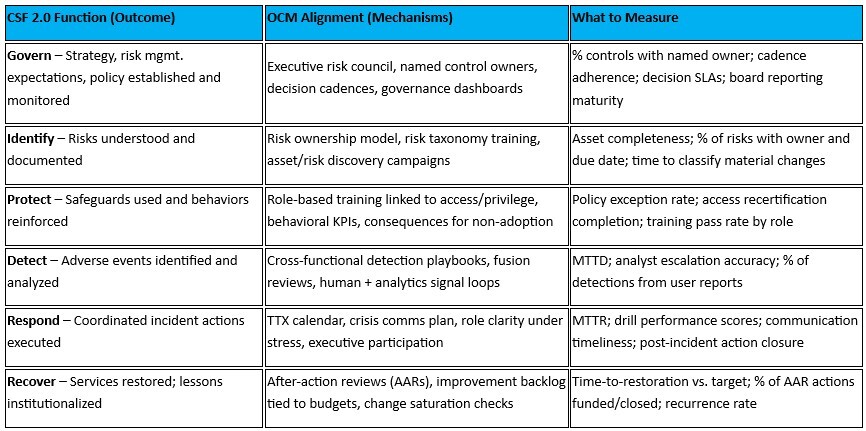
Key point: OCM turns each function into a repeatable operating habit. Without it, “adoption” remains an assumption.
4) Case-Based Patterns - What We See in the Field
- When OCM is embedded from day one, policy adoption accelerates, and exceptions drop because ownership is defined and reinforced (ISACA, 2025).
- When executives visibly sponsor cyber priorities, participation in role-based training spikes and phishing-reporting rates increase, which are indicators of a safer culture (Deloitte, 2023).
- When AARs feed governance, recovery isn’t just restoration; it’s program learning. The difference is whether lessons learned become funded backlog and change versus “readouts.”
Key Point: Practical heuristic: treat behavior as a control. If you can’t measure it, you can’t rely on it in a crisis.
5) Implementation Guide: Making OCM the “How” of CSF 2.0
Use the steps below to convert your current cybersecurity program plan into an OCM-enabled execution plan without adding bureaucratic overhead.
Step 1: Govern - Map Owners and Decisions
- Assign a named senior leader as control owner for every CSF category; publish the RACI.
- Establish a monthly governance rhythm: decisions, risk acceptance, budget moves.
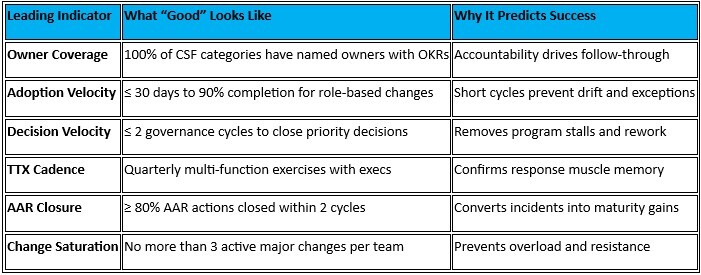
- Instrument three executive KPIs: owner coverage, decision velocity, open actions aging.
Step 2: Identify/Protect - Design for Adoption
- Build a risk ownership model that addresses services and applications.
- Deliver role-based training tied to access (e.g., elevated privileges require training modules).
- Track adoption velocity: time from policy update to 90% completion by affected roles.
Step 3: Detect/Respond - Practice Under Stress
- Calendarize tabletop exercises with leadership present. Score roles on clarity and timing.
- Route lessons into the improvement backlog with owner, budget, and due date.
Step 4: Recover - Institutionalize Learning
- Standardize AARs and link to governance.
- Measure recurrence: if the same failure pattern repeats, your OCM loop is broken.
6) Meta-Analysis: OCM Signals That Predict CSF Success
7) Leadership Actions: What CISOs, CIOs, and Boards Should Do Now
- Publish the OCM plan next to the control plan. Make enablement a tracked workstream with budget and owners.
- Measure behavior with the same rigor as controls. Add adoption and learning metrics to your dashboard.
- Bind access to competence. Tie certain privileges to passing the specific training that mitigates that exact risk.
- Make incident learning fundable. No budgeted fix, no “closed” AAR.
- Report to the board in business terms. Use risk reduction, adoption velocity, recurrence, and time-to-value alongside MTTD/MTTR.
Author Profiles
David L. Bevett, PhD ABD, MPH, MAOC, CCSFP, CHQP — vCISO, Change Agent, Sr. Cybersecurity Consultant at LevelBlue specializing in Governance, Risk, and Compliance, Program Leadership, and Organizational Change Management.
Carisa Garvalia Brockman, CISSP, CIPM, CDPSE, CCSFP, CCSKv5 — Governance, Risk, and Compliance Practice Leader at LevelBlue; two decades leading enterprise GRC programs aligned to NIST, ISO 27001, CIS, and privacy regulations.
References & Applied Research
- NIST. (2024). Cybersecurity Framework (CSF) 2.0 (CSWP 29). U.S. Department of Commerce.
- NIST. (2023). NIST SP 1299: CSF 2.0 Resource & Overview Guide.
- Prosci. (2023–2025). Correlation Between Change Management and Project Success; Change Management Principles and Best Practices. (Findings: strong positive correlation; ~6–7× objective attainment when change management is excellent.)
- ISACA. (2023–2025). Improving Information Security Through Organizational Change; The Intersection of Change Management and Cybersecurity; Cybersecurity Governance in Digital Transformation. (Guidance to integrate OCM into cyber programs.)
- Deloitte. (2023). Global Future of Cyber Survey. (C-suite perspectives on culture, strategy, and operating models for cyber.)