DarkGate Keylogger Analysis: masterofnone
Aon’s Stroz Friedberg Incident Response Services encountered a group utilizing techniques similar to ScatteredSpider and a malware called DarkGate. This blog post studies the new DarkGate encryption functionality and Stroz Friedberg's tool to decrypt these keylog files.
As cybercriminal threat actors evolve their tools to circumvent detection and to advance their attacks, it’s critical to have experienced and well-equipped incident response firm at the ready to identify, contain and remove them from your environment.
In a recent investigation, Aon’s Stroz Friedberg Incident Response Services (“Stroz Friedberg”) encountered a group utilizing techniques similar to ScatteredSpider (a.k.a UNC3944, Roasted 0ktapus) and a malware called DarkGate. This blog post studies the new DarkGate string encryption functionality we identified in a more recent sample of the malware, and further describes the malware author’s methodology for encrypting the keylog files created by DarkGate. Stroz Friedberg also has released a tool to decrypt these keylog files.
Background
In 2018, Fortinet observed DarkGate used in several crypto mining and ransomware campaigns. In 2020, Avast published a blog post about DarkGate in which they dub the malware “Meh”. Aon’s Stroz Friedberg Threat Intelligence identified an actor who started advertising DarkGate malware for sale on the dark web in May of 2023. The actor stated they had been working on this malware since 2017 and recently started renting it out. Another actor on the dark web confirmed that this malware was an earlier version of the malware analyzed by Fortinet in 2018.
The malware itself has a host of capabilities, including:
- hVNC (Hidden Virtual Network Computer) Access
- Cryptomining
- Information Stealing
- Reverse Shell Functionality
- Keylogging
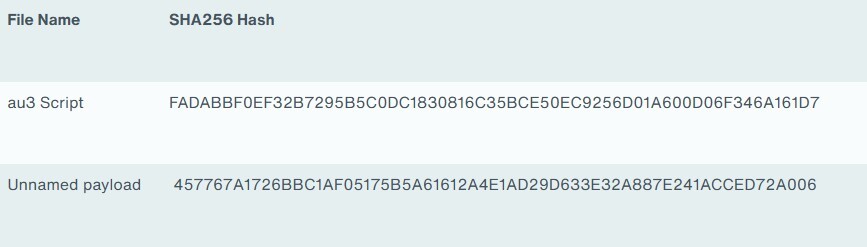
Stroz Friedberg analyzed a sample of this DarkGate malware used in 2023 that was packed in a Microsoft Software Installer (MSI) file. The MSI file installed a compiled AutoIT script which had the DarkGate payload embedded inside it. This blog post focuses on the process to decrypt strings contained within the malware as well as analysis of the keylogger functionality of the DarkGate payload. To aid with investigations, Aon’s Stroz Friedberg Incident Response team released two scripts:
- An IDA Python script to assist with string decryption of the DarkGate malware
- A Delphi program to decrypt corresponding keylog files
The Delphi program utilizes an AES-128 bit key, generated from the malware’s key string “masteroflog”, to decrypt the corresponding keylogger files. The string “masteroflog” is the same key string in this sample of DarkGate and observed by Avast in their analysis of Meh.
Technical Analysis – String Encryption Algorithm
The unpacked DarkGate malware sample that Stroz Friedberg analyzed is a 32-bit program written in Delphi. All strings related to the capabilities (e.g. hVNC, cookie theft, keylogging, etc) in the malware are encrypted with a single-byte XOR key, followed by a Base64 encoding using a custom character set. Decrypting the strings eases analysis of the DarkGate malware and allows a malware analyst to focus on important functionality of the malware.
The typical Base64 alphabet utilizes the standard character set of:
ABCDEFGHIJKLMNOPQRSTUVWXYZabcdefghijklmnopqrstuvwxyz0123456789+/=
In this version of DarkGate, the malware utilizes the following custom character set to encode their encrypted strings:
BHUPY4TaCANpsdt2zx9yXEnVkmcgl58wGbIRWSreJuKQO7fqLF3i0voZD+j1M6h=
When decrypting the encrypted strings, the malware moves the address of the encrypted and encoded string into the EAX register before calling a function that uses the custom Base64 alphabet. This MOV and CALL can be seen at 0x469B1C and 0x469B21 below.
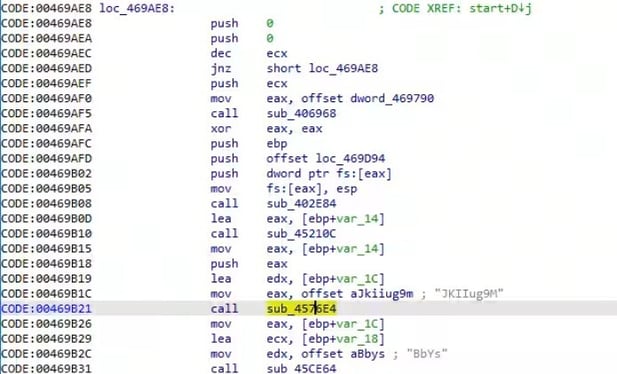
Call to the custom Base64 wrapper function at 0x4576E4 as seen in IDA Pro.
Reviewing the call to 0x4576E4 shows that it is a wrapper of the function 0x433260, which implements the Base64 algorithm with the custom alphabet. A subset of the code from sub_433260, in which the malware uses the custom Base64 alphabet, can be found below.
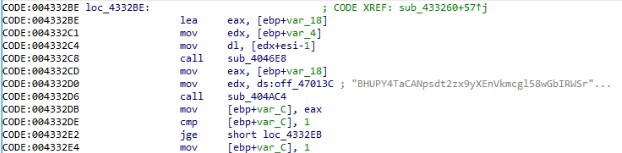
The setup of the custom Base64 alphabet.
After the custom Base64 decoding is complete, the string is sent to a decryption function. This function accepts a buffer to the decoded string along with a key. The call to this function can be seen at 0x469B31 in the figure below. The key in this example is "BbYs," although each string in the sample has its own decryption key.

The call to the decryption function with the key “BbYs".
The malware decrypts the decoded string using a single-byte XOR key. The XOR key itself is generated in code, using a single byte rolling XOR algorithm, using the following process:
- It performs an XOR operation of the length of the key and the first byte of the input buffer.
- It then takes the resulting byte and performs an XOR with the second byte of the decoded string.
- This continues until the end of the string is reached.
- The final resulting byte is used as the XOR key to decrypt the fully decoded string.
The above methodology is used for each string in the binary. Stroz Friedberg has released an IDA Python script to extract the arguments to both the custom Base64 wrapper function and the decryption function to recover the plaintext strings from the binary.
Technical Analysis – Keylogger Output Encryption
Upon successful execution, the malware begins to record various details from the system, including keystrokes, clipboard data, and process information. After it encrypts those details, the malware writes them to a file located at:
C:\ProgramData\<random 7-character string>\<random 7 character string>\DD-MM-YYYY.log
The malware stores collected information in memory and writes the data out to the above file every 30 seconds. To encrypt the key log output, the malware relies on the Delphi library DCPCrypt, a library which implements various cryptographic function for Delphi programs. The library is used to create a block cipher by passing it a key string and a hashing algorithm for generation of the cipher. The Initialization Vector (IV), another component of AES Encryption, is created by the DCPCrypt library automatically based off the key string and hashing algorithm.
In the case of the DarkGate malware, the code implements the DCPrijndael block cipher class initialized with the key string "masteroflog" and the hashing algorithm of SHA1. This can be seen in the figure below. The malware calls blockcipher_create with an argument of the DCPrijndael structure. Finally, it passes the DCPrijndael class, the DCP_sha1 constant , and the key string as arguments to the InitStr function of the DCPrijndael class. The InitStr function is where DCPCrypt generates the AES-128 bit key and the IV.
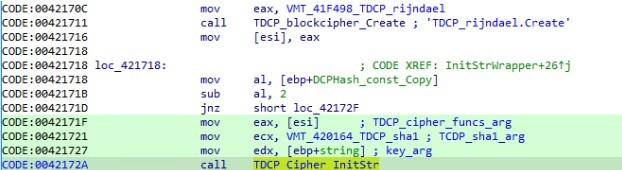
Initialization of DCPrijndael class with a SHA1 algorithm.
Prior to the call to InitStr, the malware decrypts the key string, “masteroflog” using the procedure described in the first section of this blog post. The decryption of this key string can be seen in the figure below.

Decrypted version of the string “masteroflog”.
The malware then utilizes the EncryptString and DecryptString functions of the DCPrijndael class to encrypt and decrypt the contents of the key log file. The EncryptString and DecryptString functions from the DCPCrypt library return and take encrypted Base64 strings as seen in the figure below.
Comments in the DCPCrypt library explaining functionality of EncryptString and DecryptString calls
On the backend of these functions, they implement the string encryption/decryption using the cipher in CFB8Bit mode. Some sample Delphi code has been provided below which can be leveraged to setup the cipher and decrypt a Base64 string.
KeyStr := 'masteroflog';
Base64String := '<encrypted Base64 string>'
Cipher := TDCP_rijndael.Create(nil);
Cipher.InitStr(KeyStr, TDCP_sha1);
Cipher.DecryptString(Base64String);
Tool Release
Aon's Stroz Friedberg Incident Response team has released code designed to decrypt the strings in the binary, as well as a released a Delphi executable which implements the full decryption of key log files.
Sample Analyzed