

In 2026, one theme will become impossible for security and infrastructure leaders to ignore. The architecture that once secured the enterprise no longer aligns with how the enterprise actually works. Users are everywhere. Applications are everywhere. Data is everywhere. Threats are everywhere.
What is not everywhere is consistency.
This gap between distributed reality and centralized legacy design is why Secure Access Service Edge (SASE) has become a strategic imperative rather than just another technology category. SASE is not simply the consolidation of tools. It is the creation of a unified, cloud-delivered control plane that aligns connectivity and security with the needs of a modern digital enterprise.
SASE Is More Than Convergence. It Is a New Control Plane.
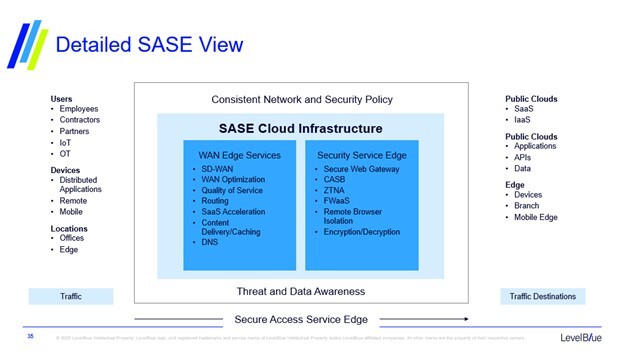
Figure 1: Detailed SASE View.
At the heart of SASE is a shift from device-centric security to identity-centric, cloud-delivered enforcement. Technically, this means:
- Inspection moves from appliances to distributed cloud fabric
- Traffic is evaluated in global points of presence with single-pass inspection, which avoids the latency penalty of chaining SWG, CASB, ZTNA, and DLP in separate tools.
- Routing decisions move closer to the application
- SD-WAN uses real-time path intelligence, application-based routing, and link conditioning to bypass congestion and optimize SaaS traffic
- Identity becomes the primary trust anchor
- Access decisions are based on user, device posture, risk score, and application context rather than network location
- Policies are unified across all traffic flows
- One policy controls web access, private app access, SaaS usage, and data movement, which eliminates the misalignment created by siloed platforms
This architecture replaces decades of perimeter-oriented assumptions. It also introduces consistency and clarity that older systems cannot deliver.
1. SASE Reduces Cybersecurity Risk Through Technical Precision
Most enterprises maintain separate stacks for VPN, firewalls, SWG, CASB, ZTNA, and DLP. Each stack has its own engines, logs, policy syntax, and inspection logic. This fragmentation creates blind spots that adversaries use to bypass controls.
SASE reduces risk by offering:
- Unified SSL decryption with a single certificate chain and shared cryptographic policy
- Continuous device posture checks integrated with identity
- Single-pass inspection that performs threat detection, DLP, URL filtering, and access control in one flow
- Inline CASB enforcement for sanctioned vs unsanctioned SaaS
- Adaptive trust scoring increases or decreases user permissions in real time
- From a technical standpoint, this is a migration from static, location-based firewall rules toward dynamic, identity-driven access that adapts as risk conditions shift.
2. SASE Improves User Experience by Re-Engineering the Data Path
Traditional architectures route traffic from remote users through a central data center for inspection. This design introduces:
- Latency
- Packet loss
- Inefficient use of backhaul circuits
- Bottlenecks during peak usage
- Poor SaaS performance
This is not a minor upgrade. It is a re-engineering of how access works at a network level. When traffic is optimized at L3, inspected at L7, and tied to identity at every step, user experience becomes both faster and more secure.
3. SASE Enables Business Agility Through Distributed Enforcement
From a technical viewpoint, SASE’s agility advantage comes from the separation of the control plane and the data plane. The control plane defines policy and identity requirements. The data plane enforces those policies in the cloud, on the device, or at a branch appliance.
This allows organizations to:
- Secure new branches without waiting for hardware shipping
- Bring acquired companies online rapidly through identity federation
- Deploy consistent SaaS and AI protections across cloud environments
- Control data movement regardless of where the application is hosted
- Agility is a direct byproduct of the architecture, not a marketing promise.
Why SASE Is Now a Strategic Imperative
Technical evolution drives business outcomes. SASE succeeds because it provides:- A unified architecture for zero trust
- A consistent enforcement model for hybrid work
- A flexible path for cloud and AI adoption
- A reduction in complexity that directly lowers risk
- A global performance model that improves user productivity
The threats organizations face today are distributed, dynamic, and intelligent. The architecture that protects them must be the same. SASE delivers that architecture. It is not simply a product category. It is the new blueprint for how secure connectivity must operate in a post-perimeter world.


